




En construcción
“The Strategic Value of Regional Integration as a Driver of Development and Resilience in the Face of Global Challenges”
Objective:
Through this initiative, the institutions coordinating the Call for Papers seek to create a platform to promote research that provides evidence-based and innovative proposals aimed at consolidating integration as a framework for public policy coordination, the generation of regional public goods, and the advancement of economic, environmental, and social development. In doing so, the initiative contributes to institutional strengthening and to the region’s strategic presence on the international stage. Submitted papers are expected to explore relevant and context-specific solutions from a regional perspective, promoting a transformative agenda grounded in the analysis of both structural and emerging challenges.
INQUIRIES:
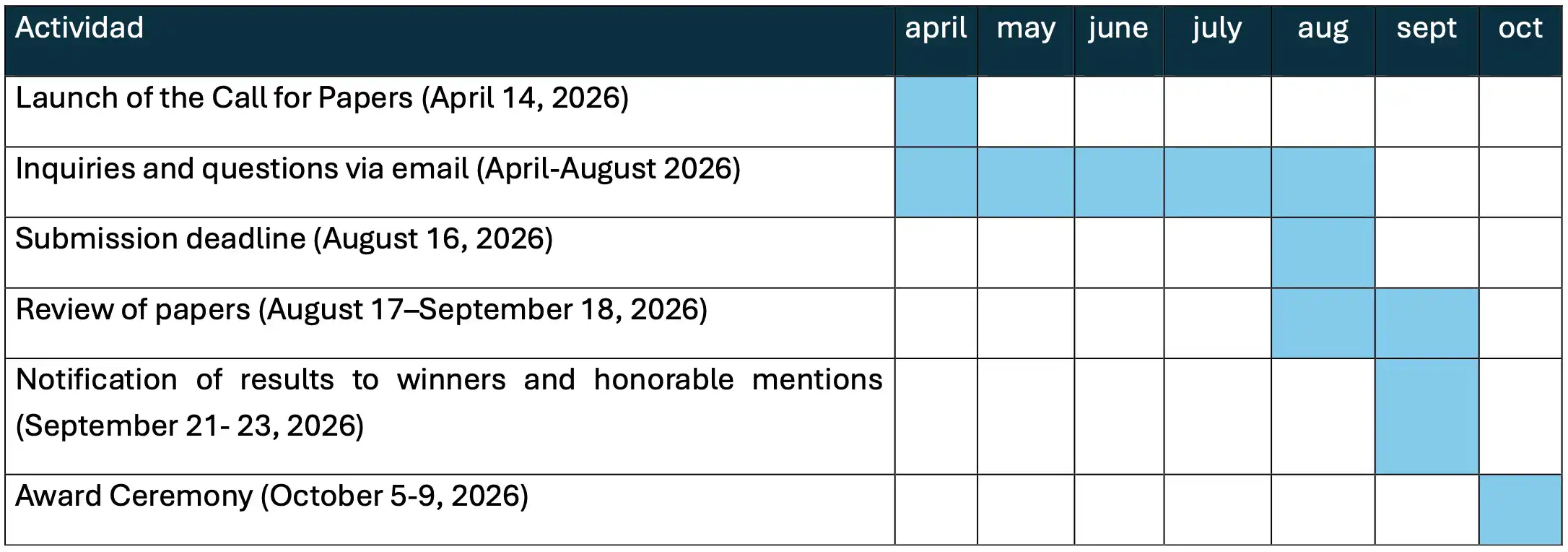
April – August 2026
APPLICATION DEADLINE:
August 16, 2026
QUESTIONS AND INQUIRIES:
formacion@sica.int with copy to: fcolocho@sica.int - disseminationodei@bcie.org and info_ceie@sieca.int
For more than 70 years, Central American integration has been an essential component in building a more united, prosperous, and supportive region. Since the entry into force of the Tegucigalpa Protocol in 1991, the Central American Integration System (SICA) has consolidated an institutional framework that coordinates the eCorts of the eight Member States — Belize, Costa Rica, El Salvador, Guatemala, Honduras, Nicaragua, Panama, and the Dominican Republic — to achieve a region of peace, freedom, democracy, and development. SICA has contributed to political consensus building,
technical and financial cooperation, and the formulation of regional responses to common challenges such as climate change, food insecurity, migration, health crises, and more recently, technological and geopolitical transformations that directly aCect the region’s economy and social cohesion.
In the current context, regional integration has become a key instrument for
strengthening the economic development and competitiveness of Member States in the global marketplace. Regulatory harmonization, trade facilitation, customs modernization, and strategic logistics infrastructure are essential components for deepening intra-regional trade and generating economies of scale. In addition, investment attraction, nearshoring opportunities, and results-based public policy evaluation serve as mechanisms to maximize the region’s economic development.
Likewise, regional governance plays a decisive role in addressing emerging challenges. Coordination in the areas of democratic security, cybersecurity, and the fight against organized crime and both physical and digital violence requires effective regional frameworks that strengthen institutional capacities to respond to these threats.
Complementarily, digital transformation and the strategic adoption of emerging technologies, including artificial intelligence, digital signatures, among others represent an opportunity to modernize public administration, enhance competitiveness, and achieve strategic progress toward development.
For its part, food and nutrition security, particularly in territories such as the Central American Dry Corridor, requires comprehensive regional approaches that promote productive resilience, climate adaptation, and the strengthening of local capacities, positioning integration as a platform for advancing territorial development.
In this context, this edition of the Call for Papers invites researchers, specialists, professionals, students, faculty members, and representatives of the academic sector to submit research proposals that contribute to enriching the debate and providing substantive inputs to the Central American integration process. Selected proposals will form part of an academic reflection space aimed at informing the development of
sectoral regional public policies under an integrative, resilient, and people-centered vision.
The development of the academic research articles will focus on three thematic areas linked to the Central American integration process.
1. Strengthening Conditions for Trade:
Competitiveness and trade development within the framework of Central
American economic integration largely depend on the harmonization of
regulatory frameworks, the digitalization of processes, and the consolidation of logistics and connectivity infrastructure that efficiently integrates its countries.
This thematic area invites to reflect on the instruments, policies, and
mechanisms that can accelerate these processes, recognizing that trade
facilitation and the free movement of goods and persons constitute
fundamental pillars for deeper regional integration, which can contribute to
poverty reduction and enhance countries’ resilience in the face of global crises.
2. Investment and Financing for Sustainable Development in Central America:
This thematic area calls for contributions analyzing how investment and
financing serve as key drivers to boost competitiveness, modernize the economy, and promote economically, socially, and environmentally sustainable development. Foreign direct investment can also foster technology transfer, strengthen human capital, and integrate national production into global supply chains.
3. Regional Governance to Strengthen the Central American Integration
Process:
Central American integration requires robust governance frameworks that
transcend national borders and enable coordinated responses to shared
challenges. This thematic area invites to explore, from a regional perspective, institutional mechanisms, public policies, and collective strategies that can strengthen the isthmus’s cohesion in the face of threats to democratic security, the opportunities offered by digital transformation, and the urgent challenges posed by the food and climate crises in the region’s most vulnerable territories.
Within the framework of the aforementioned areas, researchers are encouraged to delve into the topics listed below, without excluding other related issues and without omitting the regional perspective:
- Regulatory harmonization for trade facilitation in the region.
- Simplification, modernization, and digitalization of customs processes.
- Transport infrastructure and strategic logistics corridors for competitiveness
and regional integration in Central America. - Productive linkages and the integration of MSMEs into value chains.
- Deepening the integration process to ensure the free movement of goods and natural persons in Guatemala, El Salvador, and Honduras.
- Opportunities for improvement to attract foreign direct investment and leverage nearshoring opportunities.
- Investment and financing for competitiveness, strengthening the business climate, job creation, talent retention, and poverty reduction.
- Strengthening the business climate and social policies, regulatory frameworks, and incentives.
- Inclusion and gender equity.
- Innovative models for the integrated management of natural resources and
ecosystems in contexts of environmental vulnerability and climate change. - Regional coordination in democratic security: cybersecurity, digital violence, the fight against transnational organized crime, and restorative juvenile justice approaches.
- Innovation and digital transformation, including opportunities arising from
digitalization and the adoption of artificial intelligence to improve institutional
efficiency, digital inclusion, productive competitiveness, and the region’s
sustainable development. - Food and nutrition security in the Central American Dry Corridor: territorial resilience, climate adaptation, and capacity-building for sustainable
development. - Evaluation as a tool for public policy and results-based decision-making.
Each of the proposed topics may be analyzed from the perspective of any of the thematic pillars; therefore, researchers must indicate the thematic pillar under which their contribution falls.
The research article may be submitted in Spanish or English and must have a minimum structure that includes:
a. Cover page
The cover page of the research article must contain the following elements:
- i. title of the work,
- ii. name or pseudonym of the author or co-authors,
- iii. date of preparation of the research article, and
- iv. keywords [minimum five and maximum eight].
b. Abstract
This must be in Spanish and English. It should not exceed 150 words or 900 characters, including spaces, and should address the main points covered in the article.
Bibliographic citations, graphs, figures, and tables should not be included.
c. Body of the document
- i. Introduction
- ii. Conceptual theorical framework
- iii. Methodology
- iv. Results
- v. Discussion
- vi. Conclusion
d. Bibliographic references
- i. Citations and bibliographic references must follow the standards of
the American Psychological Association (APA) 7th edition. - ii. All bibliographic references must correspond to the citations made
within the text.
a. Length
The text of the article must be a minimum of two thousand five hundred (2,500) words and a maximum of five thousand (5,000) words, excluding:
- i. the cover page;
- ii. titles, subtitles, footnotes, tables, figures, graphs, and sources of
- iii. bibliographic references, and
- iv. annexes
Articles must be written in Word, using Times New Roman font, size 12, with single spacing and left-aligned text.
Italics should be reserved for highlighting concepts or key ideas that the author wishes to emphasize, as well as for mentioning book and magazine titles, scientific names, and words not found in Spanish. Bold or underlining should not be used for this purpose under any circumstances.
Acronyms should be written without periods or spaces and should always be preceded by the article corresponding to the main noun. In addition, acronyms should be specified the first time they are mentioned in the text, in parentheses, for example, Central American Integration System (SICA).
b. Titles
- i. Titles should be aligned to the left margin of the text, without numbering, and comply with the following criteria:
-
- Article title [bold, 14 point, Times New Roman]
- Content titles [bold, 12 point, Times New Roman]
- Level 1 subtitles [bold, 10 point, Times New Roman]
- Level 2 subtitles [bold, italics, 10 point, Times New Roman]
- Level 3 subtitles [italics, 10 point, Times New Roman]
- ii. The titles corresponding to the Bibliography and Annexes shall be written in bold, 12 point, Times New Roman.
c. Graphic elements
Graphics, figures, and tables must meet the following requirements:
- i. Graphic elements must be prepared in Excel format and incorporated into the body of the article.
- ii. In addition to the article, a single file in Excel or another program containing all the original graphic elements must be submitted.
Graphs, figures, or tables that are copied and pasted from other texts will not be accepted, even if they are properly cited. - iii. Images included in the article must be high definition.
- iv. Titles, notes, and sources for graphic elements must be included as part of the text of the document, not within the body of the graphic, figure, or table.
- v. Titles must be placed at the top of each graphic, figure, or table, indicating the time period and unit of measurement, when necessary [in bold, 12 point, Times New Roman].
- vi. Explanations of abbreviations should be included at the bottom left of each graph, figure, or table, when necessary.
- vii. Each graphic element should be numbered according to the order in which they appear in the article, identifying the type of graphic element to which they belong (graph, figure, or table). The numbering of graphic elements is restarted when another type of graphic element is added. For example: (Table 1, Table 2, Graph 1, Table 3, Figure 1, Table 4, etc.)
- viii. The title of each graph, figure, or table should appear on a line below the number of that graphic element. Titles should be aligned with the left margin of the text.
a. Participants
- i. Professionals, academics, public officials, and researchers involved and interested in the dynamics of the Central American integration process are invited to participate.
- ii. Authors of any nationality may participate.
- iii. Winners of the 6th edition, as well as officials of the General Secretariat of SICA, SIECA, and CABEI, consultants of the regional institutions of SICA, and relatives up to the fourth degree of consanguinity and second degree of affinity of the members of the Editorial Committee of the initiative, as well as the heads and representatives designated by the strategic partners of this initiative, are excluded from this call for entries.
- iv. Individuals who received honorable mentions in previous editions may participate in this call for entries.
b. Participation
- i. Participation may be individual or co-authored, with no limit on the number of researchers. In both cases, only one research paper may be submitted per author or co-author. In the case of co-authorship, all those involved must approve the submission of the article.
- ii. Participants must guarantee the authorship, originality, and unpublished nature of the work submitted, assuming the corresponding responsibilities if the intellectual property rights of third parties are violated. Unpublished work is understood to be any work that has not been published or disclosed, in whole or in part, nor is it in the process of acceptance and/or publication in any other medium, contest, or academic-scientific journal.
- iii. Participation is free of charge. No registration fees or payments of any
kind are required. Likewise, the General Secretariat of SICA, SIECA and CABEI do not assume or reimburse the costs of preparing and presenting research articles.
c. Restrictions
- i. Opinion articles will not be accepted.
- ii. Graduation papers, monographs, dissertations, and/or university theses will not be accepted. However, these works may form the basis for a new research article specifically intended for this call for papers.
- iii. Articles that have been submitted in previous editions of this call for papers will not be accepted, unless they have been substantially modified from the version previously submitted. In such cases, authors must expressly indicate the changes made at the time of submission.
-
a. Access the website: https://www.sieca.int/call-for-papers-2026/
-
b. Click on the “Registration” section to open the paper submission form.
-
c. Complete the required information in the form and attach the academic
paper and any annexes (if applicable), as established in the guidelines.
-
a. Only research that complies with the structure established in sectionbIII will be accepted for evaluation.
-
b. Articles will be disqualified if they:
-
i. exceed the established word limit
-
ii. do not present a regional focus or scalability
-
iii. contain partial or total plagiarism.
-
-
a. All articles will be reviewed by the Editorial Committee, made up of
representatives from each of the institutions coordinating the Call for Papers, to determine that they are unpublished, original, and based on rigorous research processes. The Editorial Committee will also review the articles to ensure that they do not fall within the restrictions mentioned in these guidelines. -
b. Articles that meet the requirements for research admissibility will move on to the evaluation phase, which involves two stages:
-
i. The first stage focuses on compliance with the established criteria for
form, structure, and word limit. -
ii. The second focuses on the relevance of the topic, as well as reviewing
the robustness and soundness of the scientific evidence presented in
the research This evaluation will be carried out by double-blind peer
review and the Editorial Committee.
-
- c. The criteria for evaluating the research submitted are as follows:
- i. clarity and precision in writing;
- ii. originality in contributing to the state of the art of knowledge;
- iii. validity and scientific basis;
- iv. applicability and inclusion of a regional approach, and
- v. compliance with editorial regulations.
- d. The following parameters are defined for the research awards:
- i. First place: having achieved a minimum of 90 points.
- ii. Second place: having achieved a minimum of 85 points.
- iii. Third place: having achieved a minimum of 80 points.
- e. Authors will receive information about the results of the evaluation by the Editorial Committee.
-
a. The Editorial Committee will be made up of representatives from the institutions coordinating the Call for Papers: the General Secretariat of SICA,
SIECA, and CABEI. The Editorial Committee will have sole authority to receive, review, award prizes, and/or disqualify participating articles. The Editorial Committee reserves the right to suggest editorial changes to bring the content into line with editorial policy. -
b. The Coordinating Committee shall be composed of a representative from
-
c. each of the institutions coordinating the Call for Papers: the General Secretariat of SICA, SIECA, and CABEI as the governing bodies of the initiative.
The Call for Papers includes a category of strategic partners that includes the participation of academic and research institutions or other development partners who, with the aim of enriching the initiative, contribute technical and/or financial assistance to the call.
Strategic partners may participate as observers in the meetings of the Editorial Committee, with a voice in each session to contribute technical elements that strengthen the review and evaluation process.
The following strategic partners will participate in this edition:
- a. Central American Institute of Public Administration (ICAP), providing technical assistance.
- b. ETEA Foundation, Development Institute of Loyola University, providing technical assistance.
- c. Institute of International Studies of the University of Chile, providing technical and financial assistance.
- d. The Central American Higher University Council (CSUCA), providing technical assistance.
-
a. The winning articles will be presented at an awards ceremony organized jointly by the General Secretariat of SICA, SIECA, and CABEI, to be held in the second semester of 2026.
-
b. The three best research papers will be awarded a cash prize, in the following order:
-
i. First Place: USD 3,000 plus academic benefits and/or publication.
-
ii. Second Place: USD 2,000 plus academic benefits and/or publication.
-
iii. Third Place: USD 1,000 plus academic benefits and/or publication.
-
- c. In the case of co-authorship, the financial remuneration will be divided and awarded to each co-author in equal parts.
- d. As part of the award, the winning articles may be included in academic
publications disseminated by the institutions participating in this initiative,
provided that they comply with the recommendations made by the Editorial Committee. - e. In addition to the top three places, the Editorial Committee reserves the right to recognize outstanding research papers that obtain at least 75 points with an honorable mention, which will receive a certificate accrediting them as such.
-
a. Make an internal presentation to the Editorial Committee prior to the award
event, in order to guarantee the professionalism and quality of the presentation. -
b. Participate in the regional seminars organized by the coordinating
institutions and/or strategic partners, within the year following the awarding
of the research. -
c. Grant the General Secretariat of SICA, SIECA, and CABEI the rights to publish the paper in any format, printed or digital, with full acknowledgement of the authorship of the researchers.
-
Los casos no previstos en las presentes bases serán resueltos por el Comité Coordinador, a quien compete la interpretación de estas.
First Place:
USD 3,000
Second Place:
USD 2,000
Third Place:
USD 1,000
Previous Call for Papers Results
Call for Papers Compendium 2024 – 6th Edition
Call for Papers Compendium 2023 – 5th Edition
Central America: Progress and Challenges 200 Years After Independence
Central American Integration toward the Bicentennial of Independence and 30 Years of SICA
Central American Integration and Globalization
Central American Economic Integration in a Globalized World
With the support of our strategic partners:

